

Many uPVC and composite doors secure at several points along the frame instead of relying on a single bolt. The parts are largely hidden behind the door edge, which can make a multipoint door lock seem more complicated than it is.
The principle is straightforward: one operating mechanism coordinates several locking points. This guide explains the components and what each does. It does not cover DIY adjustments, fault diagnosis or repair instructions, which are different questions.
What Is a Multipoint Locking System?
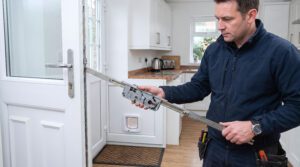
A multipoint locking system connects several locking points on one door so they can be operated together. These may be hooks, rollers, bolts or a combination, positioned at different heights along the opening edge.
The locking points engage with corresponding components fixed to the door frame. This distributes engagement beyond the central lock case and helps the door secure in the way its manufacturer intended.
A multipoint mechanism is not a collection of separate locks requiring separate keys. Its parts work as a linked assembly, normally through a central case and connected drive strip.
The Door Hardware Federation explains the difference between security arrangements used on traditional timber doors and those found on many modern uPVC or composite doors.
The security of the complete installation depends on much more than the number of locking points. The frame, keeps, cylinder, handles and correct operation all matter.
Which Types of Doors Use Multipoint Locks?
Multipoint systems are especially common in uPVC and composite entrance doors. They also appear in selected aluminium and timber doors, as well as some French and patio door arrangements.
The visible strip running along the door edge is often the first clue. Behind it, linked components allow the operating mechanism to move locking points into their positions along the frame.
Manufacturers use different designs. Some systems are operated by lifting a handle before turning the key, while others engage automatically or use alternative arrangements. A homeowner should not assume that every multipoint door has identical hardware or an identical locking sequence.
Metropolitan Police advice highlights the importance of fully securing modern multi-locking doors instead of assuming that pulling them closed is enough.
The door’s construction is as relevant as the mechanism itself. A locking strip designed for one frame and door configuration is not necessarily interchangeable with another, even if both systems are described as multipoint locks.
What Are the Main Components of a Multipoint Lock?
Most systems have a central case, a connected drive rail or strip, locking points and frame-mounted keeps. The handle operates the central mechanism, while the key cylinder provides the locking function on many designs.
The faceplate is the visible fixed strip along the door edge. Behind it, a moving drive strip links the centre case to remote locking points; the faceplate itself does not transmit the operating movement.
Hooks curve into corresponding keeps. Rollers or mushroom cams engage with their own frame components, while deadbolts or other bolts extend into suitable receiving points. The precise selection depends on the product.
These parts have different functions, but they form one coordinated locking arrangement. That is why the condition and alignment of the complete door assembly matter, even though this article does not attempt to diagnose faults.
The Secured by Design standards guide helps distinguish multipoint lock assemblies from the standards used for separate cylinders and other types of lock hardware.
What Does the Central Gearbox Do?
The gearbox, also called the centre case, is the mechanism positioned around the handle and key-operated area. It receives movement from the handle and transfers it to the linked locking points.
On a typical lift-to-lock design, internal parts translate handle movement into action along the drive strip. The exact internal arrangement varies from one manufacturer to another.
The gearbox is not the same as the euro cylinder. The cylinder permits a key to secure or release the mechanism, while the centre case coordinates the movement of its connected parts.
Keeping these roles separate avoids a common misunderstanding: a door can contain a high-security cylinder without that cylinder being responsible for moving every hook or bolt.
A professional assessment should distinguish a cylinder issue from a centre-case or linkage issue. That distinction matters when considering lock repairs, because these components have different functions.
How Do Hooks, Rollers and Deadbolts Secure a Door?
Different locking points perform different forms of engagement with the door frame. Hooks rotate or move into suitably shaped keeps; bolts project into receivers; rollers and mushroom cams use shaped contact surfaces to engage with their associated frame hardware.
Their precise behaviour depends on the mechanism. A door may contain several hooks, a mixture of hooks and rollers, or other combinations chosen by the manufacturer.
The aim is to secure the door at several locations instead of relying entirely on the centre of its opening edge. This can help the assembly resist certain forms of movement when the door is correctly closed and locked.
Police home guidance notes that certified uPVC doors commonly use linked hooks and latches and emphasises proper locking.
More locking points do not automatically make every door equally secure. The design of the complete assembly, its installation and the quality of the components determine its intended performance.
How Do the Handle and Euro Cylinder Work Together?
On a typical handle-operated design, the handle connects through a square spindle to a follower in the centre case. That connection transfers the user’s movement into the mechanism. The euro cylinder has a separate cam that interacts with the case’s locking parts.
In many lift-to-lock designs, the cylinder cam secures or releases the deadlocking function, while the spindle and follower provide the handle’s mechanical input. The precise interaction depends on the product; key-operated and automatic designs can differ.
Some doors use thumbturn cylinders, while others have different operating methods. The correct arrangement depends on the door and the manufacturer’s design, including any relevant safe-exit requirements.
DHF security advice explains the separate role of security-rated cylinders and protective door furniture. Their certification concerns cylinder protection, not whether the multipoint strip is working correctly.
Understanding these separate functions makes it easier to discuss an existing door accurately, without treating every part as one interchangeable “lock”.
What Happens When You Lift the Handle and Turn the Key?
For a common manual lift-to-lock door, first close the door fully, then lift the handle to engage its locking points. Turn the key to complete locking, then remove it. Closing the door or lifting the handle alone may not complete the locking cycle.
This is the overall sequence rather than an adjustment procedure. Automatic and alternative mechanisms can work differently, so owners should follow the instructions for their particular door.
The Metropolitan Police summarises the familiar manual procedure as lifting the handle, locking the door and removing the key. It also reminds householders that merely closing a door may not fully secure it.
To reopen this type of door, turn the correct key to unlock, then use the handle to release the locking points and open the door. Internal operation may use a key, thumbturn or another release, depending on the installed design. Follow the manufacturer’s instructions.
If the operation of your door is uncertain, qualified locksmith advice can establish which mechanism is fitted and how it should be used.
